
Cycling has undergone a training revolution since the advent of heart rate monitoring in the 1970s. No longer relying solely on perceived exertion, cyclists can now gain precise insights into their physiological response to exercise.
Using heart rate data, you can:
- Train smarter: Target specific fitness goals by training within precise heart rate zones, optimizing your efforts for endurance, power, or speed.
- Prevent overtraining: Monitor training stress and adjust your workload to maximize recovery and minimize the risk of injury.
- Track progress: Continuously monitor your performance, identify areas for improvement, and celebrate your achievements.
- Unlock peak performance: Optimize your training intensity and duration for maximum gains in speed, endurance, and overall cycling performance.
The Darefore sensor takes heart rate monitoring to the next level. By seamlessly integrating real-time position data with accurate heart rate information, it provides a comprehensive view of your performance. This allows you to analyze your training in unprecedented detail, make data-driven decisions, and ultimately achieve your cycling goals more effectively.”
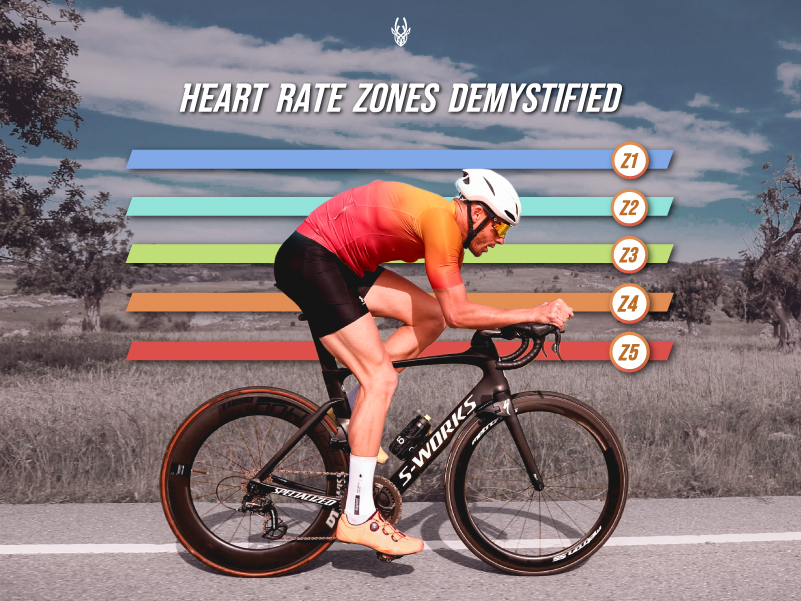
Understanding Heart Rate Zones
Heart rate zones are a valuable tool for cyclists to gauge training intensity and tailor workouts for specific goals. By dividing your heart rate range into distinct zones, you can effectively target different physiological systems.
Common Heart Rate Zones:
- Zone 1 (Recovery): Very light effort, easily maintain a conversation. Ideal for active recovery and easy rides.
- Zone 2 (Endurance): Sustained aerobic training, comfortable conversation with slightly more effort. Builds a strong aerobic base.
- Zone 3 (Tempo): Moderate intensity, conversation becomes more challenging. Improves lactate threshold.
- Zone 4 (Threshold): High intensity, difficult to maintain a conversation. Improves lactate threshold (LT) – the point where lactate buildup exceeds clearance.
- Zone 5 (Anaerobic): Highest intensity, short duration efforts. Improves anaerobic capacity.
Determining Your Heart Rate Zones
Several methods can be used to determine your individual heart rate zones:
1. Percentage of Maximum Heart Rate (MHR)
If you do not know already you MHR, the most common way to estimate your maximum heart rate (HRmax) is by using the following formula:
- 220 – Age = Estimated HRmax
Example: If you are 40 years old: 220 – 40 = 180 beats per minute (bpm)
Next, lets see how we can determine your heart rate zones using the Percentage of Maximum Heart Rate (MHR) method:
Calculate the heart rate range for each zone:
- Zone 1 (Recovery): 50-60% of MHR
- Zone 2 (Endurance): 60-70% of MHR
- Zone 3 (Tempo): 70-80% of MHR
- Zone 4 (Threshold): 80-90% of MHR
- Zone 5 (Anaerobic): 90-100% of MHR
Example:
If your estimated MHR is 180 bpm:
- Zone 1: 90-108 bpm
- Zone 2: 108-126 bpm
- Zone 3: 126-144 bpm
- Zone 4: 144-162 bpm
- Zone 5: 162-180 bpm
2. Heart Rate Reserve (HRR)
Considers resting heart rate for a more personalized approach.
To calculate HRR you subtract your resting heart rate from your Maximum Heart Rate (MHR).
For example, if your MHR is 180 bpm and your resting heart rate is 60 bpm, your HRR is 120 bpm (180 – 60 = 120).
Determine Zone Percentages:
- Calculate the percentage of your HRR for each zone.
- Then, add your resting heart rate back to these values to find the target heart rate range for each zone.
Example (using the same MHR and resting heart rate):
- Zone 1: 50-60% of HRR = 60-72 bpm
- Add resting heart rate: 60-72 bpm + 60 bpm = 120-132 bpm
- Zone 2: 60-70% of HRR = 72-84 bpm
- Add resting heart rate: 72-84 bpm + 60 bpm = 132-144 bpm
And so on for the remaining zones.
- Add resting heart rate: 72-84 bpm + 60 bpm = 132-144 bpm
Benefits of HRR:
- More Personalized: Accounts for individual variations in resting heart rate.
- More Accurate for Some: Can be more accurate than the simple MHR percentage method for some individuals.
3. Lactate Threshold Test (LT Test):
This involves performing an incremental exercise test while measuring blood lactate levels. The LT is the intensity at which lactate begins to accumulate in the blood faster than it can be cleared. This is considered the most accurate method for determining training zones.
Determining Zones:
- The heart rate at the lactate threshold is used to define the upper limit of Zone 4.
- Zones 1-3 are then determined relative to the LT heart rate.
Example:
Let’s say an athlete’s lactate threshold occurs at a heart rate of 170 beats per minute (bpm).
- Zone 4 would typically range from a lower limit (e.g., 165 bpm) up to the LT heart rate of 170 bpm.
- Zone 3 would fall below Zone 4, perhaps ranging from 155-165 bpm.
- Zones 1 and 2 would then be determined accordingly, with Zone 1 being the lowest intensity and Zone 2 falling between Zone 1 and Zone 3.
Why it’s the Most Accurate:
- Directly measures the physiological response (lactate accumulation) to exercise intensity.
- Provides a highly personalized and accurate assessment of training zones.
Note: LT tests are typically conducted in a laboratory setting and require specialized equipment and expertise.
By understanding and utilizing heart rate zones, you can tailor your training to achieve specific fitness goals and maximize your cycling performance.

Using Heart Rate for Training
Now that you understand heart rate zones, let’s explore how to effectively use them in your cycling training:
1. Endurance Training (Zone 2):
Focus: Build a strong aerobic base, increase endurance, and improve fat burning.
Characteristics:
Sustained effort over extended periods.
Comfortable conversation is possible.
Ideal for long rides, recovery rides, and base-building phases.
Example: A 2-hour ride at a conversational pace, maintaining a heart rate within Zone 2.
Now that you understand heart rate zones, let’s explore how to effectively use them in your cycling training:
Zone 2 Training: The Foundation of Endurance
Zone 2 training is the cornerstone of any successful cycling program, particularly for endurance cyclists. It’s characterized by a sustained, comfortably hard effort where you can still hold a conversation, albeit with slightly more effort than in Zone 1 (recovery).
Key Benefits
Builds a Strong Aerobic Base:
- Improves the efficiency of your body’s oxygen utilization.
- Increases the number and size of mitochondria (the “powerhouses” of your cells) responsible for energy production.
- Enhances the delivery of oxygen to working muscles.
Increases Fat Burning:
- Trains your body to utilize fat as a primary fuel source, sparing glycogen stores for more intense efforts.
- This is crucial for long-distance rides and endurance events.
Reduces Risk of Injury:
- Low-impact nature minimizes the risk of overuse injuries.
- Improves overall cardiovascular health.
Mental Toughness:
- Develops mental endurance and the ability to sustain effort over extended periods.
Enjoyable Rides:
- Zone 2 training can be a very enjoyable way to spend time on the bike, allowing you to explore new routes and enjoy the scenery.
Training Characteristics
Duration: Typically 60-120 minutes or longer.
Intensity:
- Heart rate within Zone 2 (typically 60-70% of MHR or 60-75% of FTP).
- Comfortable but sustained effort, slightly harder than a casual ride.
- Breathing should be steady and rhythmic.
Training Examples
- Long, Steady Rides: 2-3 hour rides at a consistent Zone 2 pace.
- Recovery Rides: Easy rides following hard workouts or races to aid in muscle recovery.
- Base Building Rides: Long rides (3+ hours) performed consistently throughout the base training phase.
Tips for Effective Zone 2 Training:
- Maintain Consistency: Include 2-3 Zone 2 rides per week in your training schedule.
- Vary Terrain: Incorporate gentle rolling hills or slight inclines to add variety and challenge.
- Listen to Your Body: Adjust your pace as needed based on how you feel.
- Stay Hydrated and Fueled: Consume adequate fluids and electrolytes, especially on longer rides.
In Summary
Zone 2 training is a foundational element of any successful cycling program. By consistently incorporating Zone 2 rides into your training schedule, you’ll build a strong aerobic base, improve endurance, and lay the groundwork for faster and more powerful rides

Zone 3 Training: The “Sweet Spot” for Endurance
Zone 3 training, often referred to as “tempo” or “sweet spot” training, sits between the steady grind of Zone 2 and the all-out intensity of Zone 4. It’s a challenging yet sustainable effort where you’ll feel a noticeable increase in breathing and heart rate.
Key Benefits
Lactate Threshold Improvement:
- The primary focus of Zone 3 is to increase your lactate threshold (LT).
- This is crucial because it allows you to sustain a higher intensity for longer durations before lactate buildup significantly impacts performance.
Enhanced Aerobic Efficiency:
- Further improves your body’s ability to utilize oxygen efficiently.
- Increases the capacity to transport and utilize oxygen in working muscles.
Improved Endurance:
- Builds muscular endurance and allows you to sustain higher intensities for longer periods.
Race Pace Simulation:
- For many cyclists, Zone 3 effort closely resembles race pace, making it excellent preparation for competitive events.
Training Characteristics
- Intensity:
- Heart rate within Zone 3 (typically 70-80% of MHR or 75-85% of FTP).
- Conversation becomes more challenging, but still possible in short phrases.
- Breathing becomes more labored.
- Duration:
- Typically 20-60 minutes of sustained effort.
- Can be incorporated into longer rides as intervals or sustained efforts.
Training Examples
- Tempo Rides: 45-60 minute rides at a consistent